
Synonym for Leadership: Essential Terms for Guiding Teams and Organizations
Jan 13, 2026Finding the right word to convey leadership can elevate your writing and communication. Common synonyms for leadership include management, governance, administration, direction, stewardship, and control, with over 50 alternatives available depending on your specific context. Each synonym carries subtle differences in meaning that can change how your message is received.
I've found that selecting the appropriate alternative depends on whether you're describing the act of leading, the position itself, or the qualities of a leader. Different contexts call for different synonyms, such as using "guidance" when emphasizing mentorship or "command" when highlighting authority. Understanding these nuances helps you communicate more precisely in professional and academic settings.
The effectiveness of your word choice impacts how others perceive your ideas and intentions. I'll walk you through the various categories of leadership synonyms, when to use each one, and how to match your vocabulary to your specific situation for maximum clarity and impact.
Key Takeaways
- Leadership has numerous synonyms including management, governance, administration, and stewardship that vary in meaning and application
- Context determines which synonym works best, as some emphasize guidance while others highlight authority or control
- Choosing the right alternative enhances communication precision and helps convey your intended message more effectively
Defining Synonyms for Leadership
The English language offers numerous alternatives to express the concept of leadership, each carrying distinct connotations that shape how we communicate about authority and influence. Understanding these variations helps clarify which term best fits specific organizational contexts and communication goals.
What Is a Synonym for Leadership?
A synonym for leadership is any word that conveys similar meanings related to guiding, directing, or managing others toward common objectives. According to Merriam-Webster's thesaurus, common synonyms include management, governance, administration, direction, and stewardship.
Each alternative captures different aspects of what it means to lead. For instance, command emphasizes authority and decision-making power, while guidance highlights the supportive and advisory role a leader provides. Collins American English Thesaurus lists additional terms like superintendency, control, and influence that describe various dimensions of how leaders operate.
The word you choose depends on the specific quality of leadership you want to emphasize. Some terms focus on the structural role, while others highlight the interpersonal dynamics between leaders and those they lead.
Commonly Used Alternatives
I find that certain synonyms appear more frequently in professional and academic contexts. WordHippo identifies headship, directorship, and governance as popular alternatives that maintain formal tone.
Management remains one of the most versatile substitutes, applicable across business, nonprofit, and government sectors. Administration works well when discussing organizational systems and processes. Command suits military or hierarchical environments where authority is clearly defined.
Other effective alternatives include:
- Guidance - emphasizes mentorship and support
- Direction - focuses on setting strategic paths
- Control - highlights decision-making authority
- Stewardship - suggests responsible caretaking of resources
Nuances and Context in Usage
The context dramatically changes which synonym fits best. In corporate settings, I use management or executive leadership to describe how leaders run operations. Government contexts often call for governance or administration.
Command works when discussing military leaders or situations requiring decisive authority. Guidance better suits educational or mentoring relationships where the leader serves as an advisor rather than an authoritarian figure.
Thesaurus.com lists 53 different alternatives, demonstrating how nuanced this concept truly is. The word lead itself transforms into various forms: a person might lead a team, serve as the leader, or provide leadership to an organization.
Cultural context matters too. Some organizations prefer collaborative terms like facilitation, while others embrace hierarchical language like supremacy or primacy to describe their leader's role.
Categories of Leadership Synonyms
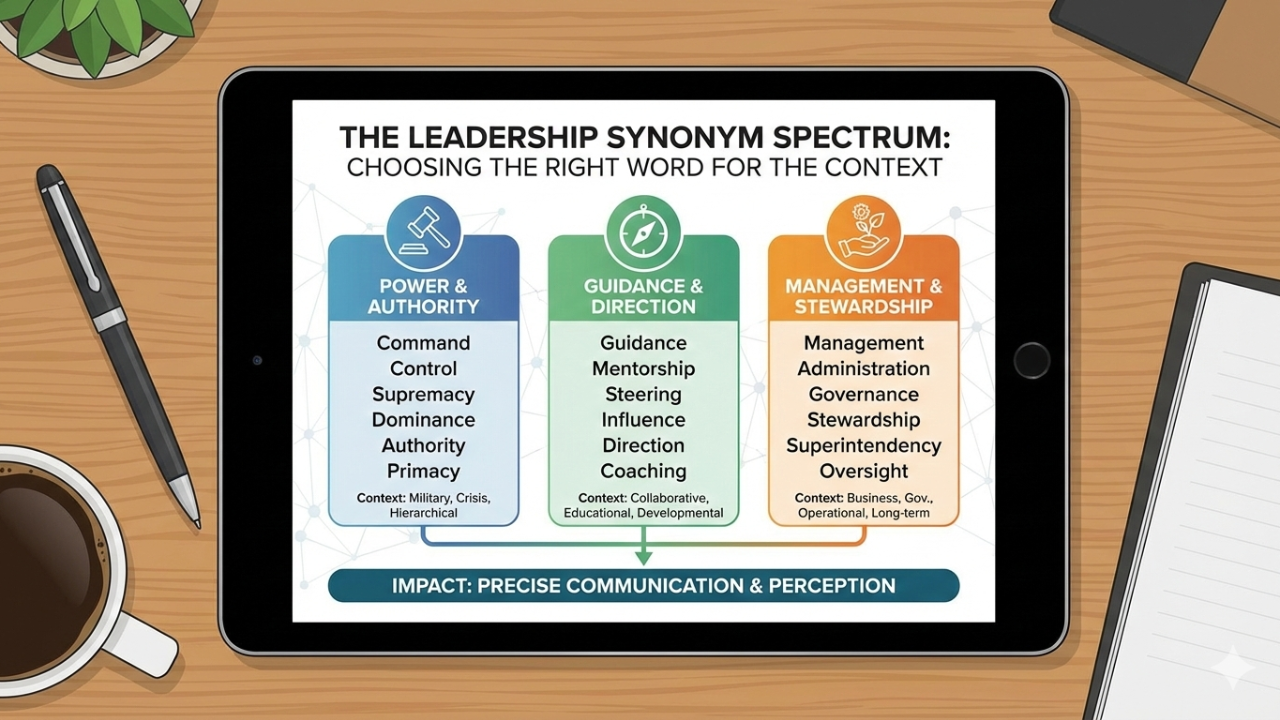
Leadership synonyms fall into distinct categories based on the specific aspects they emphasize. Some terms highlight positional power and formal authority, while others focus on the act of providing guidance or the practical aspects of organizational management.
Words Related to Power and Authority
Synonyms emphasizing authority include command, control, and supremacy. These terms reflect the formal power structures inherent in leadership roles. Command suggests direct authority over people or situations, often used in military or hierarchical contexts.
Authority represents the legitimate right to make decisions and enforce compliance. This term appears frequently in government and institutional settings where formal power structures exist. Control implies the ability to direct or regulate actions and outcomes.
Dominance and primacy are stronger alternatives that emphasize a leader's superior position. These words carry connotations of clear hierarchical relationships. I find these terms most appropriate when describing top-level executive positions or situations requiring decisive action.
Supremacy suggests the highest level of authority in a given domain. Power itself serves as a direct synonym when referring to the capacity to influence or direct others' behavior.
Terms Emphasizing Guidance and Direction
Terms focusing on guidance present leadership as a supportive rather than authoritative function. Guidance emphasizes showing the way forward through advice and mentorship. Direction refers to providing clear paths and goals for others to follow.
Steering suggests careful navigation through challenges while maintaining course. This term works well in contexts requiring adaptability and ongoing adjustments. Influence describes the ability to affect decisions and actions without necessarily holding formal authority.
I notice these synonyms appear more frequently in collaborative environments. They reflect modern leadership philosophies that prioritize coaching over commanding. Mentorship and stewardship fall into this category as well, emphasizing responsibility for others' development and organizational resources.
Management and Control Alternatives
Management-related synonyms include administration, governance, and superintendency. These terms focus on the operational aspects of leadership roles. Management emphasizes the coordination of resources and people toward organizational objectives.
Administration refers to the execution of policies and daily operations. I see this term used extensively in educational and governmental contexts. Governance describes the frameworks and processes through which organizations are directed and controlled.
Superintendency indicates oversight of complex operations or institutions. Running and stewardship emphasize ongoing responsibility for organizational success. These alternatives work best when discussing the practical execution of leadership responsibilities rather than visionary or inspirational aspects.
Headship and directorship specify formal positions at the top of organizational hierarchies.
Contextual Use of Leadership Synonyms
Different professional environments demand specific terminology to describe leadership roles and responsibilities. The choice between terms like management, governance, or command depends on organizational structure, cultural expectations, and the nature of authority being exercised.
In Business and Management
In corporate settings, I observe that management and administration are the most frequently used synonyms for leadership. Directors oversee departments or entire organizations, focusing on strategic planning and resource allocation. Chiefs, particularly in executive roles like Chief Executive Officer or Chief Operating Officer, carry responsibility for major business functions.
The term stewardship emphasizes responsible oversight of company assets and stakeholder interests. When I discuss operational control, direction describes the act of guiding teams toward specific objectives. Governance particularly applies to board-level oversight and corporate policy frameworks.
Business contexts favor terms that emphasize collaborative decision-making rather than unilateral authority. Heads of divisions or departments exercise leadership through influence and coordination rather than strict hierarchical control.
In Government and Politics
Political environments use governance as the primary alternative to leadership, reflecting the structured exercise of authority over populations and territories. Rulers historically described monarchs and autocrats, though the term now applies broadly to any governing authority.
I notice that governance leadership encompasses legislative, executive, and judicial functions. Political heads guide policy development and represent constituents or nations. The term administration specifically refers to the executive branch and its implementation of laws and programs.
Government structures emphasize legitimacy, accountability, and public service. Leaders in this context exercise power through established constitutional or legal frameworks rather than personal authority alone.
In Military and Command Structures
Military organizations rely on command as the definitive term for leadership authority. Commanders exercise direct control over personnel, operations, and strategic decisions within clearly defined hierarchies.
The terms management and control take on specific meanings in military contexts, where precision and immediate compliance are essential. Officers at various ranks hold command positions with explicit authority boundaries and responsibilities.
I find that military leadership emphasizes discipline, order, and chain of command. The term direction in military usage refers to operational guidance and mission parameters. Command structures maintain unity of effort through standardized terminology and reporting relationships that distinguish them from civilian organizations.
Choosing the Right Synonym
The context in which you communicate determines which leadership synonym fits best. Word choice affects how others perceive your role, whether you're emphasizing positional power or interpersonal influence.
Differentiating Between Influence and Authority
I distinguish between influence and authority by examining the source of power each word implies. Authority suggests formal position and the right to make decisions or give commands. This comes from organizational structure or official titles.
Influence operates differently. It reflects the ability to affect others' actions through persuasion, expertise, or relationships rather than formal power. I use "influence" when describing someone who shapes outcomes without necessarily holding a title.
Key differences:
- Authority = positional power, formal role, hierarchical control
- Influence = personal power, persuasion, earned respect
When I describe a CEO, "authority" fits because they hold official decision-making power. For a team member who guides others through expertise, "influence" captures their impact more accurately. The distinction matters in professional writing because it signals whether power stems from position or personal capability.
Selecting for Tone and Audience
I adjust my synonym choice based on who will read or hear the message. Corporate audiences expect terms like "governance" or "administration" for formal communications. These words convey structure and process.
Casual settings allow for simpler terms. "Guidance" or "direction" work well in team emails or coaching conversations. I avoid heavy terminology when addressing broad audiences who might find it pretentious.
Tone considerations:
- Formal contexts: stewardship, governance, command
- Collaborative settings: guidance, direction, coordination
- Achievement-focused: drive, initiative, vision
The right synonym strengthens communication by matching audience expectations. I choose "stewardship" when emphasizing responsible resource management. "Command" suits military or crisis contexts where decisive action matters.
Strength and Subtlety in Word Choice
I evaluate the strength each synonym carries before using it. "Command" projects forceful authority and direct control. This works when describing decisive action or emergency response situations.
Subtle alternatives like "guidance" or "mentorship" suggest supportive rather than directive approaches. I select these when highlighting collaborative or developmental aspects of leadership. The strength difference matters because it shapes how readers perceive the leader's style.
"Supremacy" and "control" carry the most intensity, implying dominance. "Oversight" and "supervision" fall in the middle range. "Facilitation" and "coordination" represent the gentlest options, emphasizing enablement over direction.
I match word strength to the actual power dynamic. Overstating with "command" when someone merely advises creates disconnect. Understating with "guidance" when describing executive authority diminishes their role. The goal is precision that reflects reality without embellishment.
Conclusion
I've explored numerous alternatives to the word leadership throughout this article to help you diversify your vocabulary. Each synonym carries its own nuances and contextual applications that can enhance your writing.
When selecting the right synonym, I recommend considering your specific context. Terms like guidance and direction work well in educational or mentoring scenarios. Stewardship and governance fit formal organizational settings.
Here are the key factors I use when choosing leadership synonyms:
- Audience: Professional, academic, or general readers
- Tone: Formal versus conversational writing
- Context: Business, politics, education, or community settings
- Connotation: Authoritative versus collaborative meanings
I find that varying your word choice prevents repetition and demonstrates vocabulary depth. Words like command, management, and supervision each emphasize different aspects of leadership roles.
The Cambridge English Thesaurus provides additional synonym resources for expanding your vocabulary further. I've used these tools to refine my own writing over time.
Remember that not all synonyms are interchangeable in every situation. Captaincy works for sports contexts but sounds awkward in corporate environments. Stewardship implies responsibility and care, while dominance suggests control and power.
I encourage you to experiment with different terms in your writing. Building a robust vocabulary takes practice and attention to context. The synonyms I've shared give you practical options for varied, precise communication about leadership concepts.
Frequently Asked Questions
Leaders often search for precise terminology to describe their abilities and roles. Understanding the nuances between different leadership terms helps professionals articulate their experience accurately in various contexts.
What term describes the capacity to guide or direct a group effectively?
The term "stewardship" effectively captures the capacity to guide or direct a group with responsibility and care. This word emphasizes the protective and nurturing aspects of guiding others toward shared objectives.
"Governance" is another strong option that highlights the structured approach to directing a group. I find this term particularly useful when describing formal leadership roles in organizations or institutions.
How can one express the concept of leadership in a resume without using the word itself?
I recommend using action-oriented terms like "spearheaded," "orchestrated," or "championed" to demonstrate leadership without stating it directly. Strategic leadership synonyms can effectively communicate accomplishments while showcasing specific skills.
Terms such as "initiative," "guidance," and "direction" work well in resume bullet points. These words convey leadership qualities through concrete examples rather than abstract claims.
Which word best captures the essence of someone's ability to manage and inspire a team?
"Influence" captures both the management and inspirational aspects of team leadership. This term suggests the ability to shape outcomes through persuasion and example rather than purely through authority.
I consider "mentorship" another powerful word that emphasizes the developmental and motivational elements of team leadership. It highlights the leader's role in nurturing growth and building capabilities within their team.
What are alternative words to describe leadership competencies?
Common alternatives for leadership competencies include "executive abilities," "management capabilities," and "directorial skills." Each term emphasizes different aspects of what makes an effective leader.
I often use "command proficiencies" to describe military or structured organizational contexts. "Supervisory aptitudes" works well for describing hands-on leadership in operational environments.
"Strategic acumen" effectively communicates high-level leadership thinking. This phrase captures the ability to see the bigger picture and make decisions that align with long-term objectives.
What terminology can one use to refer to a prominent guiding role in a project or organization?
"Principal" serves as an excellent term to describe someone in a prominent guiding role. This word conveys both authority and primary responsibility without being overly formal.
I find "architect" particularly effective when describing someone who shapes the vision and structure of an initiative. "Catalyst" works well to emphasize the role of initiating and driving change within a project or organization.
Which word is most fitting to categorize the distinct attributes of a successful leader?
"Characteristics" remains the most straightforward word to categorize leadership attributes. This neutral term allows for comprehensive descriptions without limiting the scope of qualities being discussed.
I prefer "competencies" when focusing on measurable and developable leadership traits. "Qualities" works better for describing innate or personality-based attributes that contribute to leadership effectiveness.
"Capabilities" emphasizes the functional aspects of what a leader can accomplish. This term shifts focus from abstract traits to practical abilities that produce results.

