
Customer Questions Quotation Inquiry Clarification: Best Practices for Sales Teams
Apr 21, 2026When customers reach out with questions about quotations, the clarity of your response directly impacts whether they'll move forward with a purchase. Before sending any quotation email, you should clarify the client's specific requirements and contact them for necessary clarification to ensure your quote addresses their exact needs. Misunderstandings at this stage can lead to lost sales, delayed negotiations, or damaged business relationships.
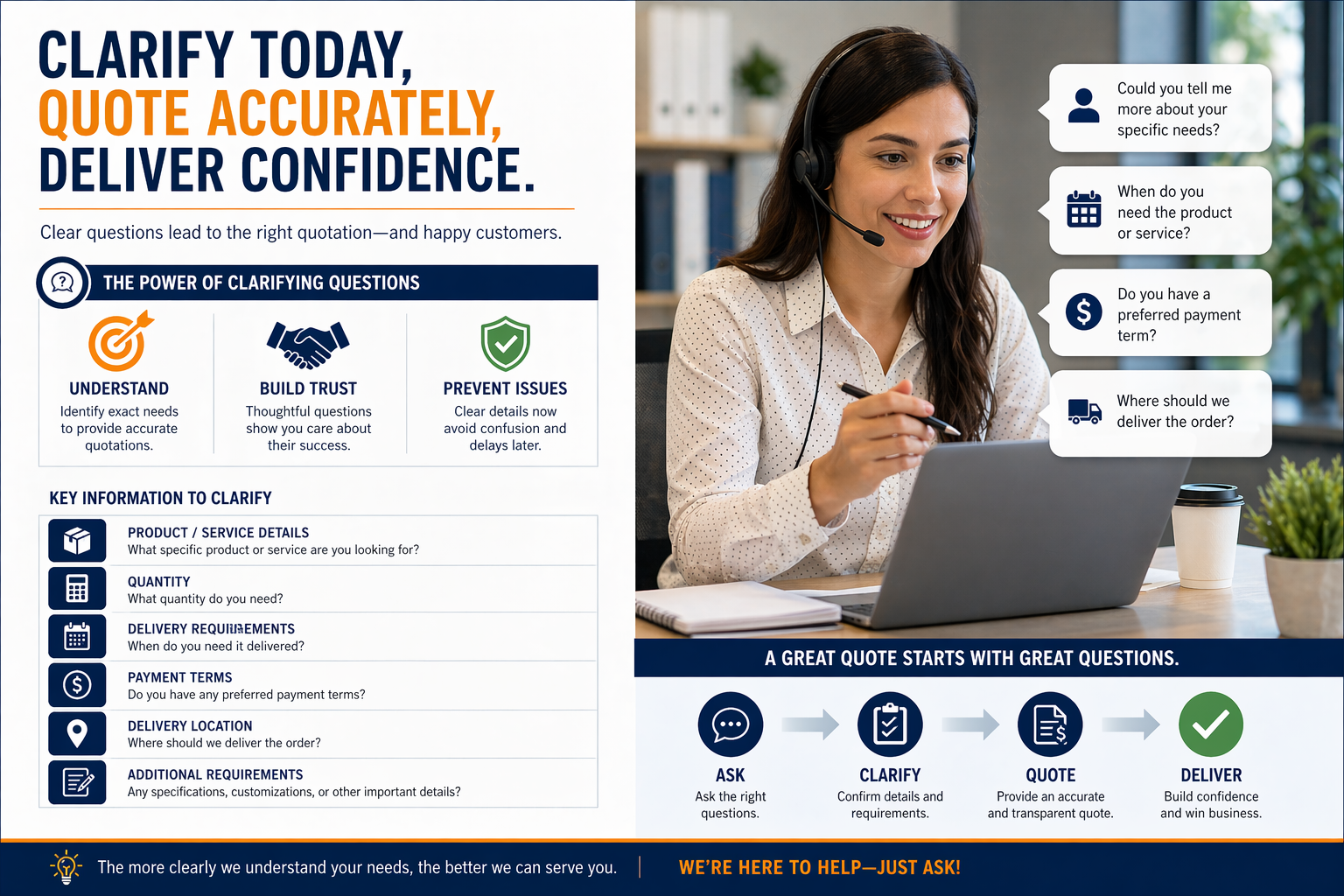
Clarifying questions in customer support serve as essential tools for preventing miscommunication and building trust with potential clients. When I receive an inquiry, I know that taking time to understand payment terms, delivery schedules, and product specifications upfront saves both parties from frustration later. This approach transforms a simple price request into a foundation for long-term customer relationships.
Mastering the art of responding to quotation requests requires balancing professionalism with responsiveness. I focus on providing comprehensive information while making it easy for customers to take the next step, whether that's confirming an order or requesting additional details about the proposal.
Key Takeaways
- Clarify all customer requirements before sending a quotation to prevent misunderstandings and ensure accuracy
- Use clarifying questions strategically to identify exact customer needs and build trust during the inquiry process
- Provide complete quotation details including payment terms, delivery schedules, and clear next steps for the customer
Understanding Customer Inquiries and Quotation Requests
Customer inquiries represent initial requests for product availability, pricing, or service details, while quotation requests formalize these needs into specific pricing proposals. Both require accurate information gathering and prompt responses to move potential customers through the sales process.
Types and Examples of Customer Inquiries
I categorize customer inquiries into several distinct types based on their purpose and urgency. Product availability inquiries ask whether specific items are in stock or can be delivered by a certain date. Pricing inquiries focus on cost information without commitment to purchase.
Technical specification inquiries request detailed product features, dimensions, or compatibility information. Service capability inquiries explore whether my organization can meet particular requirements or handle custom requests.
Common examples include:
- "Do you have 500 units of SKU-12345 available for shipment next month?"
- "What is your current pricing for bulk orders over 1,000 units?"
- "Can your product operate in temperatures ranging from -20°C to 50°C?"
- "Do you offer installation services in the Northeast region?"
Customer inquiries serve as the foundation for creating formal quotations. Each type requires different information to respond to a customer inquiry effectively.
Essential Elements of Quotation Requests
A complete quotation request must contain specific information to generate an accurate proposal. I need the customer's contact details, company name, and billing address as foundational elements.
Product or service specifications form the core of any quotation inquiry. This includes item numbers, quantities, desired delivery dates, and any customization requirements. Without precise specifications, my quotation may not align with customer expectations.
Critical quotation request components:
| Element | Purpose |
|---|---|
| Quantity | Determines volume pricing and inventory allocation |
| Delivery timeline | Affects logistics planning and availability confirmation |
| Payment terms | Establishes financial expectations and credit requirements |
| Shipping destination | Impacts freight costs and delivery feasibility |
Additional elements include preferred shipping methods, quality certifications needed, and any contractual terms the customer requires. Quotation requests differ from general inquiries because they require legally binding pricing with validity periods.
Role of Customer Service in Inquiry Management
Customer service teams act as the primary interface between inquiring customers and my organization's sales capabilities. I rely on these teams to capture complete information during initial contact, preventing delays from incomplete inquiry details.
Response time directly impacts conversion rates. When I respond to a customer inquiry within hours rather than days, the likelihood of winning business increases significantly. Customer service representatives must access product databases, inventory systems, and pricing tools to provide immediate preliminary answers.
My customer service function also manages inquiry tracking and follow-up. This includes logging each inquiry, setting reminders for quotation validity periods, and proactively contacting customers who haven't responded. Representatives escalate complex technical questions to specialized teams while maintaining ownership of the customer relationship.
Effective inquiry management requires training customer service staff on product knowledge, pricing structures, and quotation creation processes. I ensure they understand when to provide immediate answers versus when to gather information for formal quotation development.
Clarifying Customer Questions for Effective Communication
When handling customer inquiries, I focus on ensuring mutual understanding through precise clarification techniques and structured communication approaches. Preventing confusion requires proactive listening strategies, while complex situations demand systematic questioning methods that address multiple layers of customer needs.
Best Practices for Preventing Misunderstandings
I always start by practicing active listening before formulating my response to any customer inquiry. This means I pay attention to both verbal and non-verbal cues, allowing me to grasp the full context of what the customer is communicating.
Paraphrasing customer information is one technique I rely on heavily. I repeat back what I understand from the customer's statement and ask if my interpretation is correct. This creates an opportunity for immediate correction if I've misunderstood something.
I document key details during conversations to maintain accuracy throughout the interaction. When communicating through email or chat, I use bullet points to break down complex information into digestible pieces. This formatting helps both me and the customer track what has been addressed and what still needs clarification.
I also set clear expectations about response times and next steps. When I don't have an immediate answer, I acknowledge the question and provide a realistic timeframe for follow-up rather than making assumptions or providing incomplete information.
Using Clarifying Questions Appropriately
I employ different types of clarifying questions depending on the situation at hand. Open-ended questions help me gather broader context, while closed questions allow me to confirm specific details. Probing questions help me uncover underlying needs that the customer may not have explicitly stated.
Before answering a customer's question, I ask clarifying questions to ensure I understand their actual needs. This approach demonstrates genuine interest in solving their problem rather than rushing to provide a generic response.
I structure my questions to avoid overwhelming the customer. Instead of asking five questions at once, I ask one or two, wait for responses, then proceed with follow-up questions as needed. This creates a natural dialogue rather than an interrogation.
Key question types I use:
- Definitional: "What do you mean by..."
- Confirmatory: "Am I correct in understanding that..."
- Exploratory: "Can you tell me more about..."
- Prioritizing: "Which aspect is most important to you..."
I time my questions appropriately, allowing customers to finish their thoughts before interjecting. This prevents interruptions that might make them feel unheard or frustrated.
Navigating Complex Issues in Customer Communications
When facing complex issues, I break down the problem into smaller, manageable components. I address each component individually rather than trying to tackle everything simultaneously, which reduces confusion for both parties.
I use visual aids or written summaries when dealing with technical or multifaceted problems. Creating a numbered list of issues helps me track which items have been resolved and which still require attention.
For intricate customer communication scenarios, I employ the funneling technique—starting with broad questions and gradually narrowing down to specific details. This systematic approach ensures I don't miss critical information while maintaining a logical flow.
| Communication Approach | When to Use | Benefit |
|---|---|---|
| Sequential questioning | Multiple related issues | Maintains focus on one topic at a time |
| Summary statements | Long conversations | Confirms mutual understanding |
| Visual breakdowns | Technical problems | Makes abstract concepts concrete |
I acknowledge when a situation exceeds my immediate knowledge or authority. Rather than guessing or providing uncertain information, I explain what I need to investigate and commit to a specific follow-up timeframe.
Effective communication through clarifying questions builds trust with customers, especially when dealing with complicated scenarios that require multiple touchpoints to resolve fully.
Crafting Professional Responses to Customer Inquiries
Effective customer inquiry responses require a clear structure, genuine empathy, and a systematic approach that addresses questions while maintaining professional standards. Standard response times should stay under 24 hours to meet customer expectations.
Structuring a Clear and Courteous Reply
I always begin responses with a polite greeting that acknowledges the customer's inquiry directly. The opening line should reference their specific question or concern to show I've read and understood their message.
The body of my response provides detailed answers in a logical sequence. I use bullet points or numbered lists when presenting multiple pieces of information to improve readability. Each point addresses one aspect of their inquiry without unnecessary technical jargon.
I close with an invitation for follow-up questions and a professional sign-off. This structure follows best practices for responding to customer inquiries that build trust and satisfaction. The entire message maintains a consistent, professional tone while remaining conversational enough to feel personal.
Incorporating Empathy and Attentiveness
I demonstrate empathy by acknowledging any frustration or inconvenience the customer may have experienced. Phrases like "I understand your concern" or "Thank you for bringing this to my attention" validate their feelings without making assumptions.
Attentiveness means addressing every question raised in their inquiry, even minor ones. I review their message carefully before responding to ensure nothing gets overlooked. When I don't have an immediate answer, I explain what steps I'm taking to find the information they need.
I personalize responses by using the customer's name and referencing specific details from their inquiry. This approach to handling customer inquiries shows I'm treating them as individuals rather than ticket numbers. My language remains positive and solution-focused throughout the exchange.
How to Respond to a Customer Inquiry
I follow a systematic five-step process when addressing customer support requests. First, I acknowledge receipt of their inquiry promptly, even if I need time to research the full answer.
Second, I gather all relevant information about their account, order, or situation before crafting my response. Third, I draft a clear answer that directly addresses their question using customer service email templates as starting points that I customize.
Fourth, I review my response for accuracy, tone, and completeness. I check that I've provided actionable next steps when applicable. Fifth, I send the response and document the interaction for future reference.
This structured approach to customer experience ensures consistency across all inquiries while allowing flexibility for unique situations.
Addressing Quotation Details and Payment Terms
When responding to quotation inquiries, I focus on clarity in pricing structure and payment expectations to build trust and prevent misunderstandings. Complete transparency in both quotation details and payment terms sets the foundation for smooth transactions.
Providing Transparent Quotation Information
I always include specific itemized breakdowns in my quotations rather than single lump-sum figures. Each line item shows the product or service description, quantity, unit price, and total cost.
My quotations specify the validity period clearly. Most quotation validity periods range from 7-15 days depending on material cost volatility and exchange rate fluctuations. I state the exact expiration date rather than using vague terms.
I include any conditions that might affect the quoted price. This covers factors like minimum order quantities, delivery locations, installation requirements, or customization requests. I also specify what's included in the price and what constitutes additional charges.
When material costs or exchange rates are particularly volatile, I note this explicitly. I explain whether the quote is firm or subject to adjustment based on specific market conditions at the time of order confirmation.
Outlining Payment Terms Clearly
I present payment terms in straightforward language that leaves no room for interpretation. My payment terms include the total amount due, payment schedule, accepted payment methods, and any applicable taxes or fees.
Key payment elements I always specify:
- Payment due date or milestone schedule
- Accepted payment methods (wire transfer, credit card, check)
- Currency for payment
- Any deposit or advance payment requirements
- Late payment penalties or interest charges
- Early payment discounts if applicable
I indicate whether I require partial payments at project milestones or full payment upon delivery. For larger projects, I outline the percentage due at contract signing, midpoint completion, and final delivery.
Ensuring Customer Satisfaction in Quotation Exchanges
I respond to quotation inquiries within one business day to demonstrate professionalism and customer support commitment. Quick responses signal that I value the customer's time and business.
When customers request clarification on quotation details, I provide detailed explanations without defensiveness. I understand that questions about pricing or payment terms indicate genuine interest rather than criticism.
I proactively address common points of confusion before they arise. This includes explaining why certain costs exist, how my pricing compares to industry standards, and what value justifies the investment. I make myself available through multiple communication channels for follow-up questions.
If a customer questions specific charges, I break down the cost components further. I show the labor hours, material costs, overhead allocation, or other factors that contribute to the total price. This transparency builds confidence and supports customer satisfaction throughout the quotation process.
Maintaining Customer Relationships Through Effective Support
Strong customer relationships depend on consistent follow-up practices, regular measurement of satisfaction metrics, and strategic communication that builds trust over time.
Following Up on Customer Inquiries
I make follow-up communication a priority after resolving any customer question or quotation request. Prompt and effective reactions to customer inquiries help maintain strong relationships and contribute to positive word-of-mouth.
I typically reach out within 24-48 hours after providing a quotation or clarification to confirm the customer received the information they needed. This simple step shows I value their business and care about their complete understanding.
I use these follow-up conversations to gather feedback about my support process. Did they find my quotation clear? Was the clarification I provided helpful? These questions reveal gaps in my customer communication that I can address immediately.
When customers don't respond to my initial follow-up, I send one additional message after 3-5 days. I keep this message brief and focused on offering additional assistance rather than pressuring for a decision.
Measuring and Enhancing Customer Experience
I track specific metrics to understand how well my customer support meets expectations. Response time, resolution rate, and customer satisfaction scores give me concrete data about my performance.
I implement brief surveys after quotation deliveries and inquiry resolutions. A simple 1-5 rating scale with one open-ended question provides actionable insights without overwhelming customers.
Inquiry management plays a crucial role in maintaining customer satisfaction and building long-term relationships. I review my metrics monthly to identify patterns in customer feedback.
When I notice declining satisfaction scores, I examine my recent interactions for common issues. Perhaps my quotations lack clarity, or my clarifications take too long to deliver. I adjust my approach based on these findings rather than assuming I know what customers need.
Fostering Long-Term Loyalty through Communication
I personalize my customer service by referencing previous conversations and remembering specific details about each customer's needs. This demonstrates that I view them as individuals rather than transaction numbers.
I maintain consistent communication standards across all channels. Whether responding via email, phone, or chat, I use the same professional tone and thorough approach to answering questions.
Mastering customer support involves strong communication skills, empathy, and critical thinking about how to best resolve customer issues. I balance efficiency with thoroughness in every interaction.
I share relevant updates proactively when they affect pending quotations or previous inquiries. Customers appreciate learning about price changes, product modifications, or policy updates before they ask.
I document all customer interactions in my system to ensure continuity. When customers return with new questions, I review their history to provide context-aware support that acknowledges our relationship.
Frequently Asked Questions
Getting quotation details right from the start prevents revisions, delays, and customer frustration. I focus on asking targeted questions that confirm requirements, surface hidden assumptions, and establish clear boundaries around what my quote includes.
What details should I confirm with a customer before preparing a formal quotation?
I always confirm the exact product or service specifications, including models, sizes, colors, or technical requirements. This prevents me from quoting the wrong items or misunderstanding what the customer actually needs.
I verify the required quantities and whether the customer expects volume discounts or tiered pricing. I also ask about their preferred delivery location, as shipping costs can significantly affect the final price.
Payment terms need clarification upfront. I ask whether the customer expects net-30, net-60, or immediate payment, and whether they require any special invoicing procedures.
Your inquiry response should include requirement confirmation, quote basis, lead time, and payment terms. I also confirm the customer's timeline and whether they're comparing multiple vendors, which helps me prioritize the quotation appropriately.
Which clarifying questions help verify the scope, quantities, and specifications in a quote request?
I ask customers to specify exact quantities rather than ranges or estimates. "Are you looking for 100 units or 1,000 units?" gives me a concrete number to work with instead of guessing.
For specifications, I request part numbers, technical drawings, or reference materials. I ask, "Can you provide the manufacturer's specification sheet?" or "Is this item compatible with a specific system or standard?"
I clarify whether the scope includes installation, training, maintenance, or just the base product. This prevents me from under-quoting or over-quoting services the customer doesn't want.
I verify delivery requirements by asking about preferred delivery dates, acceptable lead times, and whether partial shipments are acceptable. These clarifying questions help ensure mutual understanding and identify needs accurately.
How should I ask for missing information from a customer without delaying the quotation process?
I send a preliminary acknowledgment immediately upon receiving the inquiry, even if I lack complete information. This shows the customer I received their request and I'm working on it.
I list all missing information in a single, organized email with clear questions. "To prepare an accurate quotation, I need clarification on these three points:" works better than sending multiple follow-up emails over several days.
I provide my best assumptions if the customer needs a rough estimate quickly. I write, "Based on standard specifications, the estimated price is X, but I'll refine this once you confirm the exact requirements."
Calling or emailing to ask clarifying questions before responding with a quotation ensures I meet customer needs accurately. I set a reasonable deadline for the customer to respond, such as "If I receive these details by Thursday, I can provide a formal quote by Friday afternoon."
What is the best way to confirm pricing assumptions and exclusions to avoid misunderstandings?
I explicitly state what my quote includes and what it excludes in a clear list format. "This quotation includes the base unit and standard shipping. It excludes installation, customs fees, and extended warranty coverage."
I document my assumptions about specifications, quantities, and timelines directly in the quotation. "This price assumes delivery to a commercial address with forklift access" prevents disputes later.
I ask the customer to confirm any assumptions I've made: "I've quoted based on annual volume of 5,000 units—please confirm this matches your expected usage." This gives them a chance to correct me before I finalize pricing.
I specify what would trigger a price revision, such as quantity changes, specification modifications, or delivery date adjustments. I also confirm currency, applicable taxes, and whether prices are fixed or subject to change based on material costs.
How can I clarify timelines, delivery requirements, and service levels in a quotation inquiry?
I ask when the customer needs the product or service delivered, not just when they want the quotation. "What is your required delivery date?" helps me determine if I can meet their timeline.
I confirm whether their deadline is flexible or firm. Some projects have hard deadlines tied to events or contracts, while others allow buffer time.
I specify lead times in business days rather than vague terms like "soon" or "quickly." "Standard lead time is 15 business days from order confirmation" sets clear expectations.
For service levels, I ask about their expectations for response times, support availability, and performance guarantees. I clarify whether they need 24/7 support, same-day responses, or standard business-hour coverage.
What should I include in a quotation clarification email to ensure the customer understands the proposal?
I start by confirming what the customer requested and acknowledging any specific requirements they mentioned. This shows I paid attention to their needs.
I break down the pricing into clear line items rather than providing a single lump sum. Material costs, labor, shipping, and taxes should appear separately so the customer sees exactly what they're paying for.
I include the quotation validity period, typically 7-15 days depending on factors like material volatility and exchange-rate risk. This protects me from being held to outdated pricing.
I list all terms and conditions, including payment schedules, cancellation policies, and warranty information. I also provide my contact information with multiple ways for the customer to reach me with questions, including phone, email, and my professional title.
I end with a clear call to action: "Please review this quotation and let me know if you'd like to proceed or if you need any clarification on the terms."

