
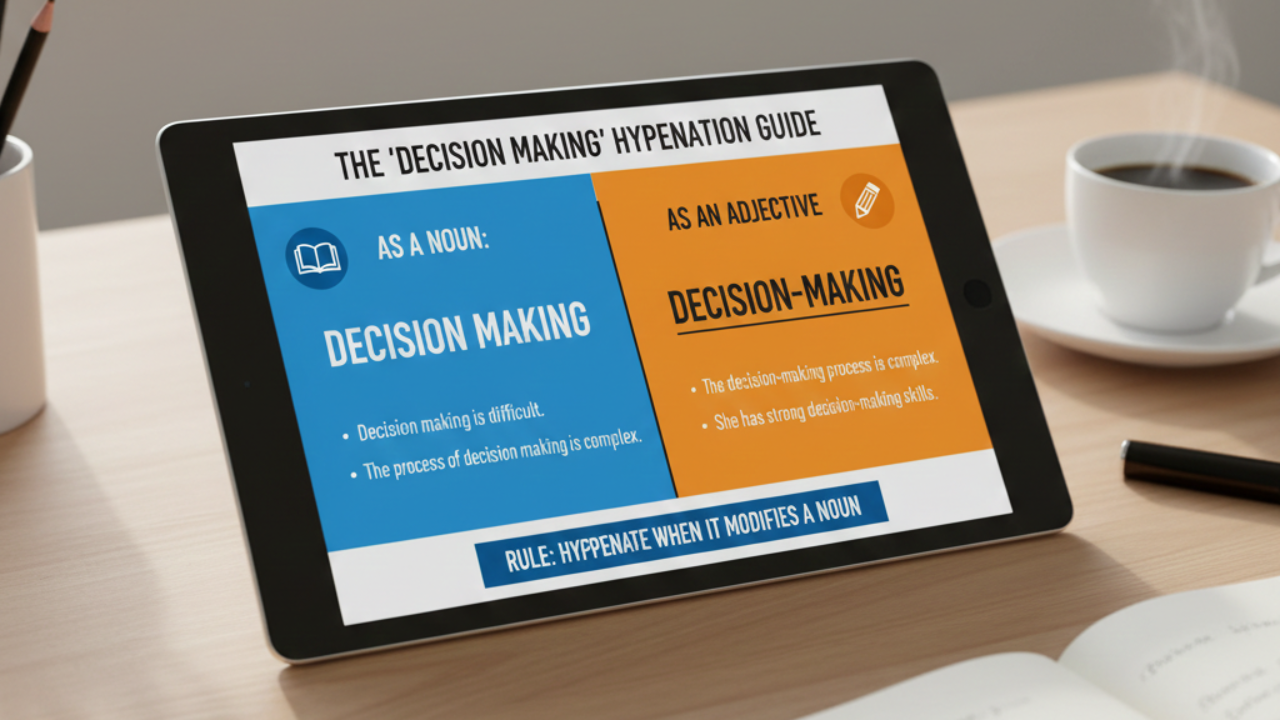
Is Decision Making Hyphenated: A Clear Grammar Guide
Jan 13, 2026The question of whether to hyphenate "decision making" confuses many writers, and the answer depends entirely on how you're using the term in your sentence. When used as an adjective before a noun, "decision-making" requires a hyphen, but when used as a noun, it typically appears as two separate words without a hyphen. Understanding this distinction will help you apply the correct form in your writing every time.
I've noticed that even experienced writers struggle with this compound term because different style guides offer varying recommendations. The confusion stems from the fact that hyphenation rules in English aren't always straightforward, and "decision making" sits at the intersection of grammar rules and evolving language conventions.
In this article, I'll break down the specific rules that govern this term, examine what major style manuals recommend, and show you practical examples that will make the correct usage second nature. Whether you're writing a business report, academic paper, or casual email, you'll know exactly when to reach for that hyphen.
Key Takeaways
- Hyphenate "decision-making" when it functions as an adjective modifying a noun
- Write "decision making" as two separate words when using it as a noun
- Major style guides generally agree on these usage rules with minor variations
Is Decision Making Hyphenated?
The hyphenation of "decision making" depends on its grammatical function in a sentence. When used as a noun, the phrase appears without a hyphen, but when functioning as a compound adjective, it requires hyphenation.
Definition of Decision Making
Decision making refers to the cognitive process of selecting a course of action from multiple alternatives. The term describes the mental activity involved in evaluating options, weighing consequences, and choosing the best solution to a problem or situation.
As a compound word, "decision making" combines two distinct elements that work together to convey a unified concept. The first word "decision" acts as a modifier for "making," creating a phrase that specifically refers to the act of reaching conclusions. Both forms of the phrase are correct, though their usage varies based on grammatical context.
The process itself encompasses identifying problems, gathering relevant information, evaluating possible alternatives, and selecting appropriate actions. This fundamental concept appears frequently in business, psychology, and professional contexts.
Usage as Noun Versus Adjective
I've found that the key distinction lies in how the phrase functions grammatically. When used as a noun, the two words remain separate, such as in "decision making is the responsibility of the manager."
However, when the compound serves as an adjective, the hyphenated form is required. This follows standard English grammar rules for compound adjectives that modify nouns.
Noun form: "The team engaged in careful decision making." Adjective form: "The decision-making process took three weeks."
The hyphen in the adjective form connects the two words to show they function as a single descriptive unit. The Chicago Manual of Style preference generally avoids hyphens in noun-plus-gerund compounds, though "decision-making" appears hyphenated in many dictionaries when used as an adjective.
Common Errors with Hyphenation
Writers frequently make mistakes by either over-hyphenating the noun form or under-hyphenating the adjective form. I often see "decision-making" incorrectly hyphenated when it serves as the subject or object of a sentence.
Another common error involves inconsistent application within the same document. Writers sometimes hyphenate the phrase in one instance and leave it open in another, creating confusion for readers.
The most problematic mistake occurs when writers assume one form works universally. They might write "the decision-making is complex" when "the decision making is complex" would be correct, or "we need better decision making skills" instead of "we need better decision-making skills." Paying attention to whether the phrase modifies a noun or stands alone as a noun itself prevents these hyphenation errors.
Official Guidelines and Style Manuals
Major style guides provide specific rules for hyphenating "decision making," though their recommendations differ based on how the term functions in a sentence. The Chicago Manual of Style maintains the strictest approach, while APA Style and Merriam-Webster offer additional context for proper usage.
Chicago Manual of Style and CMOS
The Chicago Manual of Style requires "decision-making" to be hyphenated in all contexts. According to CMOS guidelines on permanent compounds, this term appears as a hyphenated entry in the dictionary, making it a permanent compound that always takes a hyphen.
This rule applies whether I'm using the term as a noun or as an adjective. When I write about "the decision-making process" or simply refer to "decision-making" as a standalone noun, the hyphen remains mandatory under CMOS standards.
The consistency of this approach simplifies usage for writers following Chicago style. I don't need to determine the grammatical function of the term in each sentence.
Merriam-Webster Dictionary
Merriam-Webster lists "decision-making" as a hyphenated compound noun in its dictionary. This dictionary entry serves as the foundation for many style guides' recommendations.
The dictionary includes the term specifically as decision-making with the hyphen as part of its standard form. When I consult Merriam-Webster as a reference, I find the hyphenated version presented as the correct spelling.
This dictionary approach influences multiple style manuals that defer to Merriam-Webster for compound word formatting.
APA Style Recommendations
APA Style directs writers to consult both the APA Dictionary of Psychology and Merriam-Webster for hyphenation decisions. Under these guidelines, compound words may appear as two separate words, one hyphenated word, or one solid word.
For "decision-making," APA Style typically follows the Merriam-Webster standard of hyphenation. The term functions as a compound modifier in most academic contexts, particularly when describing the decision-making process in research papers.
I should note that APA prioritizes clarity and consistency in compound terms. When the term acts as an adjective before a noun, the hyphen helps readers immediately understand that the two words function as a single concept.
Grammar Rules and Hyphenation Principles
Understanding when to hyphenate compound words requires knowledge of specific grammar rules and punctuation principles. The treatment of noun + gerund constructions and the distinction between different dash types form the foundation of proper hyphenation in professional writing.
Compound Words and Noun + Gerund Constructions
I find that compound words may appear as two separate words, one hyphenated word, or one solid word depending on their function in a sentence. When a noun combines with a gerund (a verb form ending in -ing that functions as a noun), the hyphenation depends on whether the phrase acts as an adjective or a noun.
According to official writing guidelines, decision making is not hyphenated when used as a noun. I write "decision making is the responsibility of the manager" without a hyphen. However, when the same phrase modifies another noun as an adjective, I use a hyphen: "decision-making power" or "decision-making process."
The Chicago Manual of Style notes that while their preference is generally not to hyphenate noun + gerund compounds, certain terms like "decision-making" appear with hyphens in many dictionaries. This creates some variation in usage across different style guides.
Differences Between Hyphens, En Dashes, and Em Dashes
I use hyphens (-) to connect words and form compound terms. Their main purpose is to glue words together into single concepts. Hyphens appear in decision-making, self-esteem, and twenty-one.
En dashes (–) are longer than hyphens and primarily indicate ranges of numbers, dates, or pages. I write "pages 10–15" or "2020–2025" using en dashes.
Em dashes (—) are the longest and serve different purposes entirely. I use them to set off parenthetical information or create emphasis within sentences—like this example—without needing additional punctuation.
Understanding these distinctions prevents confusion in my writing. I never substitute one for another, as each punctuation mark serves a specific grammatical function.
Consistency in Professional and Academic Writing
I maintain consistency by consulting authoritative sources for hyphenation decisions. Common hyphenated terms include cost-effective and decision-making when used as adjectives, though the noun form "decision maker" appears without a hyphen.
Different style guides offer varying recommendations. The Chicago Manual insists on hyphens for decision-making regardless of function, while other guides distinguish between noun and adjective usage. I choose one style guide for each writing project and apply its rules throughout.
When I cannot locate a compound word in my chosen dictionary, I hyphenate it for clarity. I keep a personal style sheet for frequently used terms to ensure my hyphenation remains uniform across documents.
Hyphenation in Practice: Real-World Applications
Professional contexts reveal distinct patterns in how decision-making appears across legal documents, academic publications, and digital content. The hyphen consistently appears when the term functions as a compound adjective, though specific style guides and institutional preferences create variations.
Legal and Legislative Usage
In legal writing, I observe that decision-making appears hyphenated when modifying another noun. California case law and other judicial documents use "decision-making authority" or "decision-making capacity" with hyphens to establish clear legal definitions.
Operating procedures in government agencies follow this pattern consistently. Legal briefs require precision because ambiguous language can alter a document's meaning in court. When I review contracts and legislative texts, the hyphenated form appears in phrases like "decision-making process" and "decision-making powers."
Common legal applications:
- Decision-making authority
- Decision-making capacity
- Decision-making responsibility
- Decision-making framework
The noun form "decision making" appears without hyphens in legal contexts when it stands alone. For example, "The board engaged in decision making" uses no hyphen because the phrase functions as a noun rather than modifying another term.
Academic and Educational Contexts
Academic writing follows style guides that dictate hyphenation rules. I find that APA style recommends checking specific dictionaries to determine proper hyphenation for compound words.
Postgraduate research papers and dissertations typically hyphenate "decision-making" when it precedes a noun. Journal articles in psychology, business, and education use "decision-making skills" or "decision-making strategies" consistently. Educational materials for students teaching grammar often explain that temporary compounds require hyphens when they act as adjectives.
University style guides may vary slightly, but most follow major academic standards. Research proposals use "decision-making models" with hyphens, while methodology sections might refer to "the process of decision making" without one.
Usage in Online and Website Content
Website content and online publications adapt hyphenation rules for digital readability. I notice that professional blogs and business websites maintain the hyphen in "decision-making" when used as an adjective to enhance clarity and prevent confusion.
Online style guides for content writers emphasize consistency within a single website. Digital marketers write about "decision-making frameworks" in articles, while SEO specialists must decide whether to hyphenate keywords based on search patterns. Many online publications create internal style sheets that specify when to use temporary compound forms.
Technical documentation and help files typically hyphenate the term in headings like "Decision-Making Tools" or "Decision-Making Features." Content management systems and digital platforms require writers to maintain uniform hyphenation throughout all pages to preserve professional credibility.
Evolving Usage and Linguistic Trends
The hyphenation of "decision making" has shifted over time as language practices adapt to new communication formats and style preferences. Digital platforms and evolving grammatical conventions continue to shape how writers approach compound terms today.
Trends in Modern English
I observe that hyphenation practices in formal English writing are influenced by context, meaning, grammar, and discipline-specific conventions. This creates a landscape where hyphens serve as essential tools but also potential sources of inconsistency.
The usage of "decision-making" versus "decision making" varies by publication and industry. Some style guides maintain strict rules about when to hyphenate, while others allow flexibility based on function within a sentence.
I find that consistency matters more than rigid adherence to one form. Writers should establish their preferred approach and maintain it throughout their documents.
Influence of Digital Communication
Digital platforms have accelerated changes in how compound words appear in written communication. I notice that online content often omits hyphens for simplicity and faster typing.
Social media and informal digital writing favor shorter, unhyphenated forms. However, professional and academic digital publications typically preserve traditional hyphenation rules to maintain clarity.
The relationship between digital communication speed and punctuation accuracy creates tension. Writers must balance efficiency with precision when choosing whether to hyphenate terms like "decision-making."
Maintaining Relationship and Clarity
I prioritize clarity when deciding whether to use "decision-making" or "decision making." The hyphen establishes a clear relationship between the two words when they function as a compound adjective.
Maintaining consistency throughout a document helps readers understand my intended meaning. When I use decision-making as a hyphenated compound before nouns, readers immediately recognize it as a single modifier.
I recommend checking your chosen style guide and applying its rules uniformly. This approach ensures that your usage supports reader comprehension rather than creating confusion about the term's grammatical function.
Frequently Asked Questions
The hyphenation of "decision-making" varies based on style guides and grammatical context. Major dictionaries recognize it as a hyphenated compound noun, though usage differs when it appears as a noun versus an adjective.
Should 'decision-making' be hyphenated when following APA style guidelines?
APA style generally follows the principle of hyphenating compound modifiers that appear before a noun. When "decision-making" functions as an adjective preceding a noun, I hyphenate it according to APA conventions.
As a standalone noun, APA style typically hyphenates "decision-making" because major dictionaries like Merriam-Webster list it as a hyphenated compound noun. This means I would write "the decision-making was difficult" with the hyphen included.
Does the AP stylebook recommend hyphenating 'decision-making'?
AP style takes a more conservative approach to hyphenation than other style guides. The AP Stylebook generally avoids hyphens in compound modifiers when the meaning remains clear without them.
For "decision-making," I follow the pattern where noun plus gerund compounds typically appear open as nouns but hyphenated as adjectives. However, because this term appears hyphenated in standard dictionaries, I maintain the hyphen in most AP-style writing.
What are the grammatical rules for hyphenating phrases like 'decision-making'?
The phrase consists of a noun ("decision") and a gerund ("making"). I apply hyphens to connect these elements when they function as a single unit of meaning.
When the compound serves as an adjective modifying another noun, I always use a hyphen. For example, "decision-making process" requires the hyphen because the compound modifies "process."
The noun form presents more flexibility, though style guides recommend hyphenating noun plus gerund compounds when they appear in dictionaries as hyphenated terms. I maintain consistency by checking dictionary listings for the preferred form.
Is 'decision-making' considered one word or two in English dictionaries?
Standard English dictionaries treat "decision-making" as a hyphenated compound rather than a single closed word or two separate words. Merriam-Webster lists the hyphenated form "decision-making" as the standard entry.
I do not write it as one closed word ("decisionmaking") in formal contexts. The hyphenated form remains the dictionary-standard spelling across major reference sources.
How does hyphenation affect the meaning and clarity of terms like 'decision-making'?
Hyphens connect two or more words that work together to express a combined meaning. In "decision-making," the hyphen signals that "decision" and "making" form a unified concept rather than separate elements.
Without the hyphen, readers might initially parse "decision making" as two distinct concepts. The hyphen eliminates ambiguity by immediately indicating that these words function as a single term.
I find that hyphenation improves readability when compound terms modify other nouns. "Decision-making skills" reads more clearly than "decision making skills" because the hyphen shows which words group together.
In the context of 'shared decision-making', is hyphenation necessary?
The phrase "shared decision-making" requires careful attention to hyphenation rules. I hyphenate "decision-making" because it forms a compound noun that remains hyphenated in dictionaries.
The word "shared" functions as an adjective modifying the compound noun "decision-making." I do not add additional hyphens between "shared" and "decision-making" because "shared" independently modifies the entire hyphenated compound.
I write "shared decision-making" with only the single hyphen between "decision" and "making." This maintains the integrity of the compound noun while allowing the adjective "shared" to modify it naturally.

