
How to Design a Rigorous Sales Interview Process That Reduces Mis-Hires: A Strategic Framework for Better Hiring Outcomes
Apr 07, 2026Sales mis-hires cost companies far more than just a bad quarter. When you bring on the wrong salesperson, you're looking at wasted salary, lost revenue opportunities, damaged client relationships, and the time investment required to restart the entire hiring process. The stakes are high, which means your interview process needs to be equally rigorous.
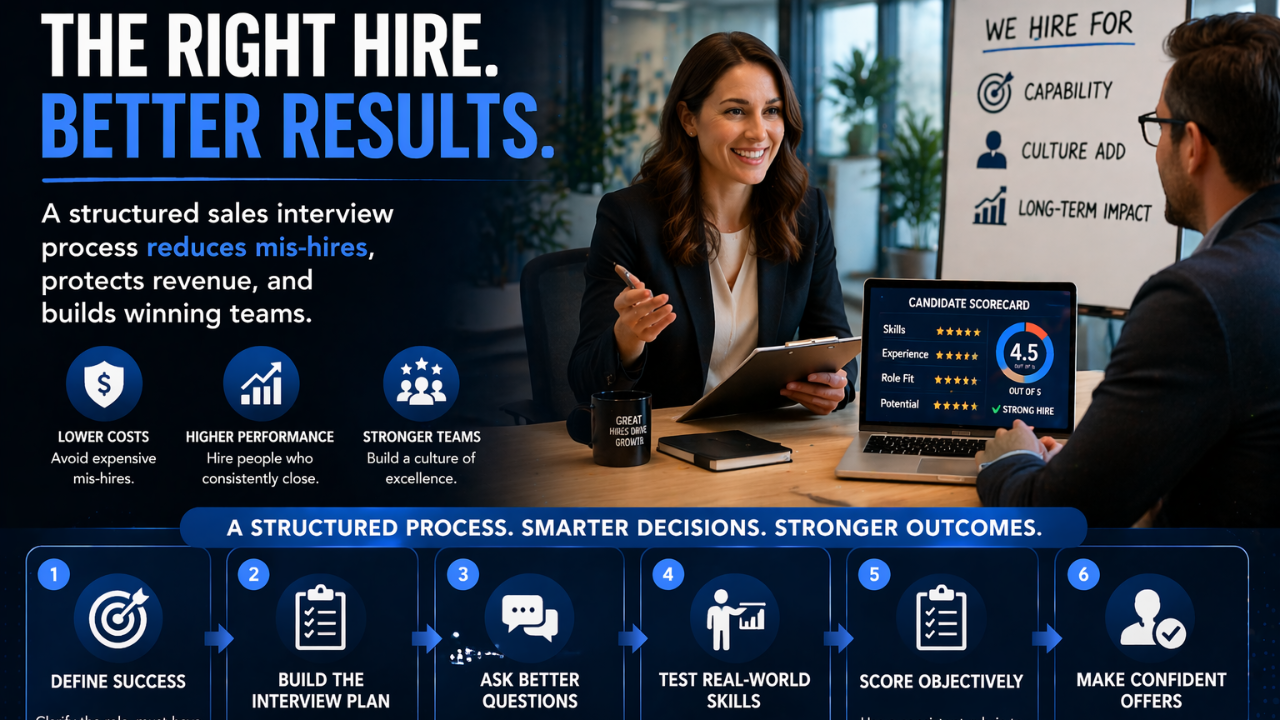
A structured sales interview process that uses standardized questions, role-specific assessments, and objective scoring criteria significantly reduces mis-hires by removing guesswork and bias from hiring decisions. Organizations that implement a structured interview process experience better hiring outcomes compared to those relying on informal conversations and gut feelings. When every candidate faces the same evaluation framework, you can accurately compare their capabilities and predict their likelihood of success in your specific sales environment.
I've seen too many sales teams struggle because they rushed through interviews or relied on charm over competence. Building a structured interview process improves hiring quality, reduces bias, and enhances candidate experience while protecting your organization from costly mistakes. The good news is that designing this kind of rigorous process doesn't require reinventing the wheel—it just requires following proven steps that I'll walk you through.
Key Takeaways
- Structured interviews with standardized questions and scoring systems eliminate bias and improve prediction accuracy for sales success
- Effective sales hiring requires combining behavioral interviews, skills assessments, and role-playing scenarios to evaluate real capabilities
- A well-designed interview process protects your revenue by ensuring only candidates who fit your sales methodology and culture make it through
Why Rigorous Sales Interview Processes Reduce Mis-Hires
Sales mis-hires drain resources and damage team performance in ways that extend beyond the immediate financial loss. A structured hiring process with validated assessment methods directly addresses the specific challenges of evaluating sales talent and significantly improves the accuracy of hiring decisions.
The Cost and Impact of Sales Mis-Hires
Research from Brandon Hall Group shows that more than two-thirds of companies identified poor interview processes as the culprit behind bad hires. The financial impact extends well beyond the initial recruiting costs.
A mis-hire in sales typically costs between 1.5 to 3 times the employee's annual salary when I factor in recruitment expenses, training time, lost productivity, and missed revenue opportunities. The cultural and operational damage compounds these direct costs.
Sales teams experience disrupted dynamics when a mis-hire fails to perform. Existing team members must compensate for the underperformer's missed quotas. Customer relationships suffer when the wrong salesperson manages key accounts.
The timeline to identify and correct a mis-hire often stretches 6 to 12 months. During this period, the territory or accounts assigned to that person generate minimal revenue while competitors gain ground.
Unique Challenges in Sales Hiring
Sales hiring presents distinct challenges that generic interview processes fail to address. Many candidates excel at selling themselves during interviews but lack the ability to sell products or services effectively.
I must evaluate skills that don't surface in typical interview settings:
- Resilience under rejection - handling repeated "no" responses without losing motivation
- Pipeline management - organizing and prioritizing multiple opportunities simultaneously
- Consultative selling ability - diagnosing customer needs rather than pushing products
- Deal closing skills - navigating objections and securing commitments
Traditional interviews that rely solely on gut instincts and lack structured processes lead to mis-hires. Past sales success at other companies doesn't guarantee future performance in my organization's specific selling environment.
The charisma that makes someone likable in interviews can mask deficiencies in strategic thinking, work ethic, or coachability. Without rigorous assessment methods, I risk selecting candidates who interview well but perform poorly.
Predictive Validity of Interview Methods
Different interview methods vary dramatically in their ability to predict job performance. Unstructured interviews have a predictive validity of approximately 0.20, meaning they explain only 20% of variance in future performance.
Structured interviews increase predictive validity to 0.58 when combined with work sample assessments. I achieve the highest accuracy by implementing multiple evaluation methods:
| Assessment Method | Predictive Validity |
|---|---|
| Unstructured interviews | 0.20 |
| Structured behavioral interviews | 0.51 |
| Work sample tests | 0.54 |
| Combined structured approach | 0.58+ |
A systematic interview process that includes structured questions and standardized evaluations allows me to compare candidates objectively. I use the same criteria for each person, which reduces subjective judgments.
Work sample assessments, such as mock sales calls or case studies, reveal how candidates actually perform sales tasks rather than how they describe their abilities. This approach to talent acquisition provides concrete evidence of skills before I extend an offer.
Foundations of Successful Sales Hiring
A successful sales interview process begins with clarity about who you're looking for and ensuring everyone involved in hiring agrees on those criteria. Without these foundations, even the most structured interview process will produce inconsistent results.
Defining the Ideal Candidate Profile
I start every sales hiring process by creating a detailed ideal candidate profile that goes beyond generic qualifications. This profile should specify the exact skills, experience, and traits that predict success in your specific sales environment.
The profile must address several critical dimensions:
- Sales methodology experience (consultative selling, transactional sales, enterprise sales)
- Industry knowledge requirements (essential vs. nice-to-have)
- Technical competencies (CRM proficiency, product demonstration ability)
- Personality traits (resilience, coachability, competitive drive)
- Performance metrics (quota attainment history, deal sizes, sales cycle length)
I translate these dimensions into clear evaluation criteria that can be measured during candidate screening. For example, rather than listing "strong communication skills," I specify "ability to articulate complex value propositions to C-level executives" if that's what the role demands.
The ideal candidate profile serves as the foundation for every subsequent hiring decision. I share this document with all interviewers and use it to develop targeted interview questions and assessment exercises.
Role of Intake Meetings and Stakeholder Alignment
I conduct an intake meeting with all stakeholders before starting the interview process. This meeting ensures that sales leadership, hiring managers, and other interviewers align on what success looks like for the role.
During the intake meeting, I address these key areas:
- Agreement on the ideal candidate profile and non-negotiable requirements
- Assignment of specific evaluation criteria to each interviewer
- Discussion of the sales environment and team dynamics the new hire will join
- Review of compensation structure and how it aligns with candidate expectations
Stakeholder alignment prevents the common problem where different interviewers assess candidates using their own personal preferences rather than objective criteria. When everyone evaluates different aspects of the candidate against the same profile, I can make data-driven hiring decisions instead of relying on gut feelings.
Designing a Structured Sales Interview Process
A structured interview process applies the same questions and evaluation criteria to every candidate, which eliminates the inconsistency that leads to expensive mis-hires. Building a rigorous interview process is essential for sales roles where the cost of a bad hire is substantial and competition for talent is intense.
Structured Interviews versus Traditional Methods
In traditional unstructured interviews, I see hiring managers make small talk, ask random questions about resume points, and improvise based on candidate responses. This approach turns interviews into what one expert calls a "charisma lottery" rather than a repeatable measurement that maps to quota and ramp-time.
Structured interviews require every candidate to answer identical questions in the same order, evaluated against predetermined scoring criteria. This standardized approach allows me to make data-driven decisions rather than relying on gut feelings.
The difference in outcomes is significant. Structured interviewing dramatically improves hiring quality by reducing bias and creating consistent evaluation standards. I can compare candidates objectively when everyone answers the same questions under the same conditions.
Creating a Structured Interview Guide
My structured interview guide serves as a blueprint that every interviewer follows without deviation. I start by identifying the specific competencies required for sales success in my organization, such as consultative selling skills, objection handling, and pipeline management.
I then map 4-6 interview stages, assigning specific competencies to each stage. For example, I might evaluate communication skills in the first round and strategic thinking in the second. Each stage includes detailed instructions for interviewers, time allocations, and scoring rubrics.
The guide must specify the exact questions, the order they're asked, and what constitutes strong versus weak responses. I include probe questions to dig deeper when candidates give surface-level answers. Creating this documentation ensures consistency even when different team members conduct interviews.
Standardizing Interview Questions for Sales Roles
I design standardized questions that directly assess sales-specific capabilities rather than general aptitude. Behavioral questions work best because they reveal how candidates have actually performed in past situations, not how they think they might perform.
Here are question types I prioritize:
- Prospecting: "Walk me through your approach to identifying and qualifying new leads in your last role."
- Discovery: "Describe a time when you uncovered a customer need they didn't initially express."
- Closing: "Tell me about a complex deal you closed despite significant obstacles."
- Rejection handling: "Give me an example of how you responded after losing a major opportunity."
I ask every candidate the same follow-up questions to probe depth of experience. For instance, after the closing question, I always ask about deal size, sales cycle length, and what they learned. This consistency allows me to compare responses across all candidates using identical benchmarks.
Building Effective Evaluation and Scoring Systems
Standardized scoring rubrics and independent assessment protocols transform subjective hiring decisions into data-driven processes that identify top sales performers while minimizing bias and mis-hires.
Developing and Using Scoring Rubrics
I design scoring rubrics by first identifying the specific competencies that predict success in the sales role. Each competency requires clear evaluation criteria with detailed descriptions of what constitutes poor, average, and excellent performance.
My interview scorecard includes both quantitative metrics and qualitative observations. I assign numerical values to each criterion, typically using a 1-5 scale, where each number corresponds to specific behavioral indicators. For example, when evaluating objection handling, a score of 3 might indicate "addresses basic concerns but misses underlying issues," while a 5 represents "proactively identifies root concerns and reframes them as opportunities."
I ensure scoring systems remain effective through continuous refinement. After each hiring cycle, I review which scored attributes correlated with actual job performance and adjust the rubric accordingly. This iterative approach prevents scoring drift and maintains predictive accuracy.
Independent and Objective Candidate Assessment
I require each interviewer to complete their scoring independently before any team discussion occurs. This prevents groupthink and anchoring bias, where one interviewer's strong opinion influences others' assessments.
My process mandates that interviewers submit scores within two hours of completing their interview session. They document specific examples that justify each score, creating an objective assessment trail that can be reviewed later. I prohibit hallway conversations about candidates until all interviewers have submitted their independent evaluations.
I compile scores in a matrix that reveals patterns across different evaluators. When I see significant scoring discrepancies for the same candidate, it signals either unclear rubric definitions or potential interviewer bias that requires calibration sessions.
Advanced Sales Interview Techniques and Assessments
Moving beyond basic qualification checks requires implementing structured evaluation methods that reveal how candidates actually perform under pressure. Behavioral and situational questions combined with practical assessments create a comprehensive picture of sales capability.
Behavioral and Situational Questions for Sales
I structure behavioral questions around the STAR method to understand past performance patterns. These questions should focus on specific sales scenarios like handling objections, losing deals, or managing difficult clients. I ask candidates to describe the Situation, explain their Task, detail their Action, and share the Result.
Situational questions test forward-thinking ability by presenting hypothetical challenges. I pose scenarios like "A prospect goes silent after three follow-ups" or "Your main competitor undercuts your pricing by 30%." The responses reveal problem-solving approaches and sales instincts.
I prioritize questions that expose red flags early in candidate screening. Questions about quota attainment, deal cycle management, and pipeline building separate genuine performers from those who exaggerate results. I also probe for coachability by asking how they've implemented feedback from previous managers.
Simulations, Role Plays, and Technical Tasks
Role-play exercises remain the most predictive assessment tool I use. I create scenarios matching actual sales situations the candidate will face, from cold calls to enterprise negotiations. This structured evaluation process tests real-time thinking and communication skills.
I design simulations with clear scoring criteria covering discovery questions, objection handling, and closing techniques. The candidate might need to pitch our product, qualify a resistant prospect, or negotiate contract terms. I play the buyer role with specific objections and constraints.
Technical tasks assess CRM proficiency, data analysis, and proposal creation. I might ask candidates to build a territory plan, analyze pipeline metrics, or create a presentation deck. These assignments reveal organizational skills and attention to detail that surface only through practical work samples.
Optimizing the Interview Experience and Process Efficiency
A well-designed interview process balances candidate satisfaction with organizational efficiency. Reducing time-to-hire while maintaining evaluation quality requires deliberate scheduling practices, structured feedback sessions, consistent interviewer preparation, and attention to the candidate journey.
Strategies to Improve Candidate Experience
I prioritize transparent communication throughout the interview process to improve candidate experience. Candidates deserve clear timelines, detailed role expectations, and prompt updates after each interview stage.
I provide candidates with specific information about what to expect during each interview. This includes the format, duration, topics to be covered, and names and roles of interviewers. When candidates know what's coming, they perform better and feel more respected.
Respecting candidates' time is non-negotiable. I avoid redundant questions across multiple interviews and ensure each conversation serves a distinct purpose. I also offer flexible scheduling options and minimize the total number of interview rounds to three or four maximum.
I gather feedback from candidates about their interview experience through brief surveys. This data reveals friction points in my process that I might otherwise miss. Common issues include unclear next steps, excessive delays between stages, and lack of role clarity.
Efficient Interview Scheduling and Post-Interview Debrief
I use scheduling automation tools to eliminate the back-and-forth emails that delay interview coordination. Interview scheduling efficiency directly impacts my ability to secure top sales talent before competitors do.
I conduct post-interview debriefs within 24 hours while observations remain fresh. During these sessions, I require interviewers to reference specific examples from their conversations rather than general impressions. Each interviewer shares their assessment against predetermined competencies before group discussion begins.
I structure debriefs with these components:
- Individual scoring submission before the meeting
- Evidence-based discussion of candidate performance
- Consensus building on strengths and concerns
- Clear next-step decision with assigned ownership
I document debrief outcomes immediately to create an audit trail for data-driven hiring decisions. This record helps me identify patterns in successful hires and refine my evaluation criteria over time.
Improving Time-to-Hire and Offer Acceptance Rate
I track my time-to-hire metric from initial contact to offer acceptance. Sales roles require urgency, and candidates often evaluate multiple opportunities simultaneously. My target is to complete the entire process within 10-14 business days.
I improve my offer acceptance rate by selling the opportunity throughout the interview process, not just at the end. Each interviewer shares genuine insights about team culture, growth opportunities, and what makes our organization unique.
I make competitive offers quickly after final interviews. Delays signal indecision or lack of enthusiasm. I prepare offer parameters in advance so I can move immediately when I identify the right candidate.
I maintain engagement with candidates between interview stages through brief check-ins. These touchpoints prevent ghosting and demonstrate my continued interest. I also use this time to answer questions and address concerns that might otherwise surface as objections to an offer.
Ensuring Consistency with Interviewer Training
I provide structured interviewer training to ensure every candidate receives a fair, consistent evaluation. Untrained interviewers rely on gut feelings rather than objective assessment of sales competencies.
My training program covers:
- Behavioral interviewing techniques for eliciting specific examples
- Unconscious bias recognition and mitigation strategies
- Scorecard utilization for standardized evaluation
- Legal compliance regarding prohibited questions
- Cultural fit assessment based on defined values
I require all interviewers to complete training before participating in candidate evaluations. I also conduct refresher sessions annually to reinforce best practices and introduce process improvements.
I observe new interviewers during their first few interviews and provide coaching feedback. This hands-on development ensures they understand how to probe effectively, take useful notes, and assess candidates against our competency framework rather than personal preferences.
Frequently Asked Questions
A structured sales interview process requires specific frameworks, evaluation tools, and proven techniques to identify candidates who will actually perform. These questions address the practical mechanics of building an interview system that filters out mis-hires before they join your team.
What are the essential stages of an effective sales hiring interview funnel?
I structure my sales interview funnel in four distinct stages to systematically narrow the candidate pool. The first stage involves a brief phone screen to verify basic qualifications and confirm genuine interest in the role.
The second stage consists of a behavioral interview focused on past sales performance and specific situations they've handled. I use this conversation to understand how they've approached challenges, closed deals, and recovered from setbacks.
The third stage incorporates practical assessments and role-play exercises to observe selling skills in action. This reveals their ability to handle objections, ask discovery questions, and adapt their pitch in real time.
The final stage brings candidates back for a culture fit interview with team members they'd work alongside. I also use this meeting to dive deeper into compensation expectations and career goals to ensure long-term alignment.
Which structured interview questions best predict sales performance across different roles?
I ask candidates to walk me through their entire sales process from prospecting to close, which reveals their understanding of the full sales cycle. This question exposes gaps in their knowledge and shows whether they follow a disciplined approach.
For discovery skills, I ask them to describe a time when they uncovered a need the prospect didn't initially recognize. Strong performers tell stories with specific details about the questions they asked and how they reframed the conversation.
I also probe their quota attainment by asking where they've ranked against their peers over the past three years. Top salespeople will have concrete numbers and percentages ready without hesitation.
To assess resilience, I ask about their longest sales slump and exactly how they worked their way out of it. This question separates candidates who take ownership from those who blame external factors.
How can scorecards and competency rubrics be used to evaluate candidates consistently?
I create a scorecard before interviewing anyone that defines 5-7 key competencies required for the specific sales role. Each competency gets a clear 1-5 rating scale with behavioral anchors that describe what each score looks like.
For example, my "objection handling" competency might rate a 5 when the candidate demonstrates multiple frameworks for reframing objections and provides specific examples of turning skeptics into buyers. A 3 might show basic competence with standard responses, while a 1 indicates they struggle to address pushback effectively.
I require every interviewer involved in the process to complete the same scorecard independently immediately after their session. This prevents recency bias and ensures we're measuring candidates against predetermined criteria rather than gut feelings.
When I review scorecards across the interview team, I look for patterns and significant discrepancies that warrant discussion. Turning interviews from a charisma lottery into repeatable measurement requires this level of documentation and calibration.
What does the 70/30 rule in hiring mean, and how should it be applied to sales interviews?
The 70/30 rule means candidates should talk 70% of the time while I listen and observe for the remaining 30%. This ratio ensures I gather enough information to make an informed decision rather than selling the candidate on the role prematurely.
I apply this rule by asking open-ended questions that require detailed responses rather than yes/no answers. When candidates give surface-level answers, I use follow-up probes like "tell me more about that" or "walk me through your specific approach."
Many hiring managers make the mistake of controlling the conversation and leaving little room for candidates to engage. I track my talk time consciously and redirect when I notice myself explaining too much about our company or products.
The 70/30 split also reveals whether candidates have strong communication skills and can hold a conversation naturally. Salespeople who struggle to fill the space or provide vague responses during interviews will likely struggle with prospects.
Which interview red flags most reliably indicate a high risk of a sales mis-hire?
I consider it a major red flag when candidates can't provide specific numbers about their past performance. Vague claims like "I exceeded quota most quarters" without percentages or rankings suggest they're either hiding poor results or lack attention to detail.
Another warning sign appears when candidates blame external factors for lost deals or missed targets. I listen for patterns of blaming bad leads, inadequate support, pricing issues, or market conditions rather than examining their own contribution.
Job hopping with tenures under 12 months at multiple companies raises concerns about cultural fit and staying power. While one short stint might have a valid explanation, a pattern indicates the candidate may struggle with commitment or performance expectations.
I also watch for candidates who can't articulate their sales methodology or process clearly. Top performers have refined systems they follow consistently, while struggling reps tend to wing it without a repeatable framework.
Overly aggressive or pushy behavior during the interview itself often translates to similar problems with prospects. I need salespeople who can read the room and adjust their approach rather than bulldozing through conversations.
How should work samples, role-plays, and practical assessments be calibrated to reflect real sales work?
I design role-play scenarios based on actual situations my sales team encounters regularly rather than generic exercises. This might include handling a specific objection we hear frequently or conducting discovery with a prospect profile matching our ideal customer.
For the role-play, I provide candidates with basic context about the prospect 15-20 minutes before the exercise. This simulates real preparation time without giving them days to over-rehearse a scripted pitch.
I play the prospect role authentically, using real objections and questions my team faces. I resist the urge to make it too easy or too hard, instead maintaining a realistic level of skepticism and interest.
When evaluating work samples like custom pitch decks or account plans, I assess whether candidates researched our company and tailored their approach. Generic templates copied from previous roles demonstrate laziness rather than genuine interest.
I also incorporate a brief presentation exercise where candidates teach me something unrelated to sales in 5 minutes. This reveals their ability to simplify complex information, engage an audience, and structure a clear message under time pressure.

