
Abraham Lincoln Quotes: Timeless Wisdom from America's 16th President
Apr 21, 2026Abraham Lincoln served as the 16th president of the United States from March 1861 until his assassination in April 1865, leading the nation through its greatest constitutional and moral crisis. His words continue to resonate today because they address universal themes of freedom, democracy, justice, and human dignity. I've gathered Lincoln's most powerful quotations to show how his wisdom remains relevant for modern challenges in leadership, governance, and personal character.
Lincoln's ability to communicate complex ideas through simple, memorable language made him one of history's most quoted leaders. From famous sayings about happiness and friendship to profound statements on liberty and equality, his words carry weight because they emerged from lived experience during America's darkest period.
I'll explore the context behind his most iconic statements, examine how they've shaped American values, and reveal why these quotations continue to inspire people worldwide. Whether you're seeking leadership guidance, historical insight, or personal motivation, Lincoln's words offer timeless wisdom that transcends their 19th-century origins.
Key Takeaways
- Abraham Lincoln's quotes address universal themes of leadership, freedom, and human dignity that remain relevant today
- His most famous quotations emerged from speeches and writings during the Civil War and reflect his experiences leading a divided nation
- Lincoln's words continue to inspire modern readers seeking guidance on governance, personal character, and overcoming adversity
Most Iconic Abraham Lincoln Quotations
Abraham Lincoln's words continue to resonate because they address timeless themes of governance, human dignity, and personal accountability. His most memorable statements reveal his approach to leadership during crisis and his vision for a unified nation.
Leadership and Unity
Lincoln understood that division weakened nations from within. His famous warning that "a house divided against itself cannot stand" came from an 1858 speech addressing slavery's expansion. This quotation drew on biblical language to argue that the United States could not endure permanently half slave and half free.
I find his observation that "America will never be destroyed from the outside" equally compelling. Lincoln believed internal discord posed the greatest threat to the republic. He emphasized that if destruction came, it would be through the nation's own actions and divisions.
The Gettysburg Address contains perhaps his most recognized opening: "Four score and seven years ago." This 1863 speech reframed the Civil War as a test of whether democratic government could survive. Lincoln connected the conflict to the founding principles of equality and self-governance. His call for a "new birth of freedom" transformed the war's meaning beyond merely preserving the Union.
Freedom and Democracy
Lincoln's quotes on leadership and freedom consistently elevated democratic principles above partisan interests. He stated that "government of the people, by the people, for the people, shall not perish from the earth," establishing an enduring definition of democracy's purpose.
His views on equality challenged the status quo of his era. Lincoln argued that all men deserved the fruits of their labor and the opportunity to improve their condition. While his positions evolved throughout his career, his fundamental belief in human dignity remained constant.
Key democratic principles in Lincoln's quotations:
- Popular sovereignty - Government derives legitimacy from the consent of the governed
- Equal opportunity - All individuals deserve access to economic advancement
- Rule of law - Legal frameworks must apply equally regardless of status
Responsibility and Character
Lincoln's statement "you cannot escape the responsibility of tomorrow by evading it today" speaks to personal accountability. This quotation reflects his belief that avoiding difficult decisions only compounds future problems.
I see his quotes on success as equally instructive about character. He advised "whatever you are, be a good one," emphasizing excellence over ambition. Lincoln believed integrity mattered more than achievement.
His approach to enemies demonstrated moral leadership. When asked why he didn't destroy his opponents, Lincoln replied, "Do I not destroy my enemies when I make them my friends?" This perspective prioritized reconciliation over retribution, a philosophy that would guide his plans for post-war reconstruction before his assassination in 1865.
Famous Speeches and Their Legacy
Lincoln's oratory shaped American political discourse through carefully crafted arguments about democracy, union, and human rights. His speeches from Springfield to Washington demonstrate a progression from local attorney to national leader addressing fundamental questions about the nation's survival.
Gettysburg Address
The Gettysburg Address remains one of the most recognized American speeches despite lasting only two minutes. Lincoln opened with the iconic phrase "Four score and seven years ago" to frame the Civil War as a test of whether democratic government could endure. The speech redefined the war's purpose from merely preserving the Union to creating a "new birth of freedom."
I find it remarkable that Lincoln composed just 272 words that transformed a battlefield dedication into a statement about national purpose. He connected the 1863 present to the founding principles of 1776, arguing that the soldiers' sacrifice gave the nation an obligation to complete their unfinished work. The address drew from the collected works of Abraham Lincoln that showcase his evolution as a thinker and leader.
Lyceum Address
In 1838, the young Lincoln delivered the Lyceum Address to the Young Men's Lyceum of Springfield, Illinois, warning against the dangers of mob law and political violence. He argued that threats to American institutions would come not from foreign invasion but from internal lawlessness and disregard for legal order. Lincoln called for cultivating reverence for the laws as the "political religion of the nation."
This early speech revealed themes that would define his presidency decades later. I see in the Lyceum Address Lincoln's belief that passion must yield to reason and that constitutional order depends on citizens' voluntary respect for legal processes. His concern about demagogues who might exploit public disorder proved prescient.
A House Divided Speech
Lincoln's 1858 speech accepting the Republican nomination for U.S. Senate introduced the metaphor "a house divided against itself cannot stand." He argued that the nation could not permanently exist half slave and half free, directly challenging the idea that sectional compromise could resolve the slavery question indefinitely.
The speech cost him the Senate election but established his national reputation. Lincoln predicted that slavery would either be placed on a path toward extinction or become lawful everywhere. This clarity about the stakes of the slavery debate separated him from politicians seeking middle ground and positioned him for the presidency two years later.
Wisdom on Governance, Law, and Society
Lincoln's guidance on governance emphasized the rule of law, democratic principles, and the responsible exercise of power. His insights on these fundamental aspects of American government reflected both his legal background and his experience leading the nation through its greatest crisis.
Democracy and American Ideals
Lincoln believed that America's strength came from its commitment to democratic principles and self-governance. He famously warned that "America will never be destroyed from the outside" but rather faced its greatest threats from internal division and the erosion of its founding ideals. His dedication to preserving the Union stemmed from his conviction that democracy itself was on trial.
The 16th president saw the Declaration of Independence as the foundation of American identity. He consistently returned to its promise that all men are created equal, even when that principle remained unfulfilled. Lincoln argued that the Constitution and democratic institutions existed to move the nation closer to these ideals, not to maintain the status quo.
His approach to leadership included surrounding himself with capable advisors, even former rivals. This strategy, later chronicled in the team of rivals concept, demonstrated his belief that effective governance required diverse perspectives and strong debate. He valued competence and dedication to the Union above personal loyalty or political agreement.
Views on Law and Order
Lincoln's legal training shaped his profound respect for the rule of law. He advocated for "reverence for the laws" as essential to maintaining a free society. In an 1838 speech, he argued that every American should pledge to uphold the Constitution and laws, making legal adherence a civic religion.
He strongly opposed "mob law" and vigilante justice. Lincoln believed that allowing citizens to bypass legal procedures, even for seemingly just causes, would inevitably lead to chaos and tyranny. Once people decided which laws to follow based on personal judgment, the entire legal framework would collapse.
His writings in the Collected Works of Abraham Lincoln reveal his view that laws must apply equally to all citizens. He saw legal consistency as the barrier between civilization and anarchy. Even when laws seemed inadequate or unjust, he maintained that changing them through proper channels preserved social order better than circumventing them.
Quotes on Power and Responsibility
Lincoln understood that power carried inherent dangers and required careful restraint. He observed that nearly all men could withstand adversity, but few could handle power without corruption. This awareness influenced his measured approach to presidential authority during the Civil War.
He believed leaders must answer to the people and accept criticism as part of democratic governance. Lincoln endured harsh attacks from newspapers, political opponents, and even members of his own cabinet, yet he defended press freedom and open debate. His tolerance for dissent reflected his conviction that accountability prevented tyranny.
The president emphasized that government existed to serve citizens, not to aggrandize those in power. He viewed his role as temporary steward of the nation's welfare, responsible for preserving the Union and expanding liberty. Lincoln rejected the notion that leaders should seek power for personal gain or glory, insisting instead that public service required sacrifice and humility.
Collected Works and Interpretations
The authoritative compilation of Lincoln's writings provides scholars and readers access to his authentic voice, while modern historians have shaped how we understand and contextualize his most famous statements. The multi-volume edition remains the primary reference for verifying Lincoln quotations, and influential historical works have brought renewed attention to the context surrounding his words.
The Collected Works of Abraham Lincoln
The Collected Works of Abraham Lincoln was originally published by ALA in 1953 and established the standard authority for Lincoln's speeches and writings. The multi-volume set compiles Lincoln's correspondence, speeches, and other writings in chronological order. Edited by Roy P. Basler and others, this edition provides scholars with verified source material for authenticating quotes.
The collection now exists in electronic form through the efforts of the Abraham Lincoln Association, making it more accessible to researchers and the public. When I verify a Lincoln quote, I reference this compilation because it includes detailed citations with dates and contexts for each document. The Lincoln Papers at the Library of Congress contain approximately 40,550 documents dating from 1774 to 1948, with most spanning the 1850s through his presidency.
Influence of Team of Rivals
Doris Kearns Goodwin's Team of Rivals brought Lincoln's cabinet dynamics and leadership philosophy to a wider audience beyond academic circles. The book examined how Lincoln assembled his cabinet from former political opponents, including William Seward, Salmon Chase, and Edward Bates. This work influenced how modern readers interpret Lincoln's quotes about unity, leadership, and political strategy.
The book's popularity led to renewed interest in Lincoln's pragmatic approach to governance and his ability to work with those who disagreed with him. Many frequently shared Lincoln quotes about listening to opposing viewpoints and building consensus gained additional context through this lens.
The Role of Doris Kearns Goodwin
Doris Kearns Goodwin shaped contemporary understanding of Lincoln through accessible historical narrative that connected his words to specific historical moments. Her biographical approach emphasized the personal and political pressures Lincoln faced when delivering his most memorable statements. By focusing on the relationships within his administration, she provided readers with frameworks for understanding why Lincoln chose particular words and approaches.
Her work helped bridge academic Lincoln scholarship with popular understanding, making the context behind famous quotations more widely known. This contextual approach changed how many people read and apply Lincoln's words to modern situations.
Timeless Inspiration and Modern Relevance
Abraham Lincoln's words continue to resonate because they address fundamental human experiences like perseverance, character development, and the pursuit of meaningful goals. His insights shaped not only his era but continue to influence how Americans think about leadership and personal responsibility.
Quotes on Success and Personal Growth
Lincoln's approach to success emphasized persistence over natural talent. He famously stated, "I will prepare and some day my chance will come," reflecting his belief that readiness matters more than opportunity alone. This perspective came from his own journey from poverty to the presidency.
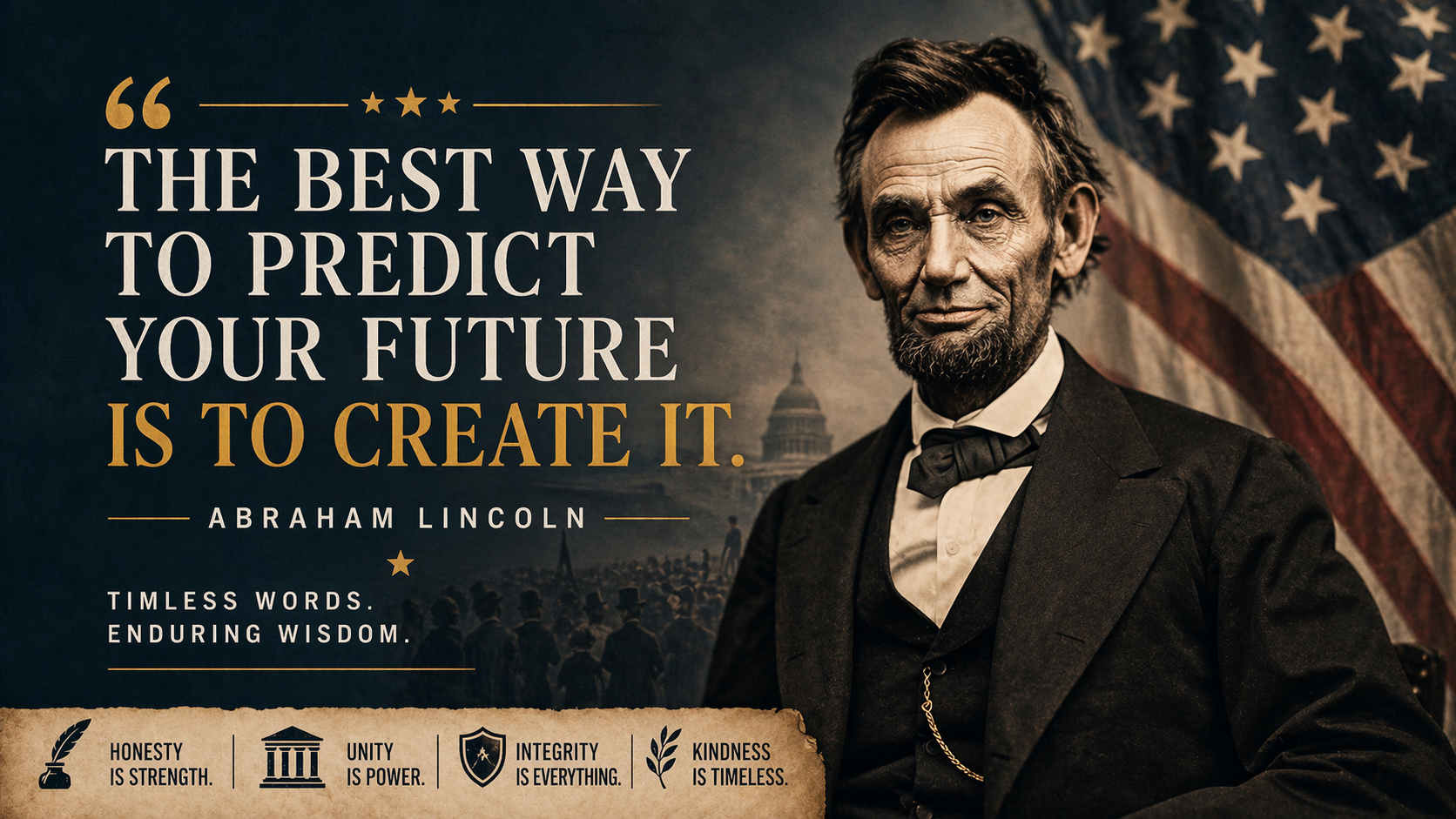
His quotes on success often focused on self-improvement and determination. Lincoln believed that "The best way to predict your future is to create it," encouraging active participation in shaping one's destiny. He also emphasized that "Always bear in mind that your own resolution to succeed is more important than any other," placing responsibility squarely on individual commitment.
Lincoln's thoughts on personal growth remain practical for modern challenges. He understood that failure serves as education, not endpoint. His own political defeats and business failures preceded his greatest achievements, making his words particularly authentic when he spoke about resilience and continuous learning.
Lasting Impact on American Culture
Lincoln quotations appear in schools, government buildings, and popular media because they articulate core American values. His words about democracy, equality, and national unity became reference points for civil rights leaders, presidents, and citizens debating the country's direction.
The continuing relevance of Lincoln's words stems from their focus on universal principles rather than temporary politics. When he spoke about government "of the people, by the people, for the people," he created a standard against which Americans still measure their institutions. His emphasis on honest labor, education, and equal opportunity shaped cultural expectations about success.
Modern leaders frequently reference Abraham Lincoln quotes when addressing national crises or moral questions. His ability to articulate complex ideas simply made his words accessible across generations and education levels, ensuring their continued circulation in American discourse.
Frequently Asked Questions
Lincoln's words continue to resonate across generations, prompting questions about their authenticity, meaning, and application. I've compiled answers to the most common inquiries about his quotations and their historical context.
What are Abraham Lincoln's most famous sayings?
Lincoln's most recognized quote is "government of the people, by the people, for the people" from the Gettysburg Address. This phrase encapsulates his vision of democratic governance and remains one of the most quoted lines in American political history.
Another widely known saying is "a house divided against itself cannot stand," which Lincoln used in his 1858 speech about slavery's divisive impact on the nation. The Abraham Lincoln Presidential Library and Museum catalogs more than 550 quotes attributed to him across various topics.
"Four score and seven years ago" opens the Gettysburg Address and has become iconic in American rhetoric. His statement that "all men are created equal" appears repeatedly in his speeches, reflecting his interpretation of the Declaration of Independence.
Which Lincoln quotations best capture his views on leadership?
Lincoln believed that "nearly all men can stand adversity, but if you want to test a man's character, give him power." This quote reflects his understanding that true leadership emerges through how individuals handle authority rather than hardship.
He stated, "I am a firm believer in the people. If given the truth, they can be depended upon to meet any national crisis." I find this demonstrates his faith in citizens' judgment when provided with honest information.
Lincoln wrote, "I do the very best I know how, the very best I can, and I mean to keep on doing so until the end." This reveals his commitment to persistent effort and continuous improvement in leadership responsibilities.
What did Lincoln say about democracy and government by the people?
Beyond the famous Gettysburg Address phrase, Lincoln declared that "the ballot is stronger than the bullet." This statement emphasizes his belief in democratic processes over violence as the foundation of legitimate governance.
He wrote that "public sentiment is everything. With public sentiment, nothing can fail; without it nothing can succeed." I see this as his recognition that democratic government requires popular support to function effectively.
Lincoln maintained that "no man is good enough to govern another man without that other's consent." This principle underlies his opposition to slavery and his broader conception of self-governance as a natural right.
What are notable Lincoln quotes about war and national unity?
During the Civil War, Lincoln said, "we are not enemies, but friends. We must not be enemies." He spoke these words in his first inaugural address, appealing for reconciliation even as conflict loomed.
He wrote in a letter that "the fiery trial through which we pass will light us down in honor or dishonor to the latest generation." I interpret this as his understanding that the war's outcome would define America's legacy for centuries.
Lincoln stated, "I have always found that mercy bears richer fruits than strict justice." This reflects his approach to reconciliation and his plans for reconstructing the Union without excessive punishment of Confederate states.
Which Lincoln quotes are most often cited about character and integrity?
Lincoln famously said, "I am not bound to win, but I am bound to be true. I am not bound to succeed, but I am bound to live by the light that I have." This quote appears frequently in discussions about ethical leadership and personal integrity.
He advised, "stand with anybody that stands right, stand with him while he is right and part with him when he goes wrong." I find this demonstrates his principle of supporting ideas rather than blind loyalty to individuals.
Lincoln wrote, "no man has a good enough memory to be a successful liar." Many historians note that some widely quoted Lincoln phrases have disputed origins, making verification important.
What are some widely shared Lincoln quotes about life, success, and perseverance?
Lincoln declared, "the best way to predict your future is to create it." However, I should note that attribution of this quote remains debated among historians, as is common with many Lincoln sayings.
He wrote, "I walk slowly, but I never walk backward." This reflects his methodical approach to progress and his refusal to abandon principles despite setbacks.
Lincoln stated, "things may come to those who wait, but only the things left by those who hustle." This emphasizes his belief in active effort over passive hope. His quote "I will prepare and some day my chance will come" reveals his dedication to readiness and continuous self-improvement.

